Panda Patch: Why BAM Built Our Own Remote Audio Connection Platform
Remote recording has become an everyday part of audio post.
Talent might be in Los Angeles. The director could be in New York. The agency is in Chicago. A producer is joining from somewhere else entirely. And everyone still needs to hear each other, see picture when necessary, give direction, record high-quality audio, and keep the session moving.
At BAM, we’ve connected remote sessions using just about every professional platform available. They all have their place.
But after years of recording VO, ADR, advertising, animation, film, television, podcasts, and other projects remotely, we kept coming back to the same thought:
There has to be a simpler way to do this.
So we started building one. We call it Panda Patch.
The Idea Came From the Studio
Panda Patch didn’t begin with a software feature list. It began with sessions.
Anyone who works in professional audio knows how quickly a remote session can become unnecessarily complicated. Someone can’t connect. An application needs to be installed or updated. Audio is routed incorrectly. A firewall gets in the way. A client needs another link.
Meanwhile, the session clock is running.
Technology that is supposed to connect everyone can suddenly become the focus of the session. That has always bothered us.
At BAM, our job isn’t to impress clients with how complicated our technology is. Our job is to make the technology disappear so everyone can concentrate on the work.
That became the philosophy behind Panda Patch.
What Is Panda Patch?
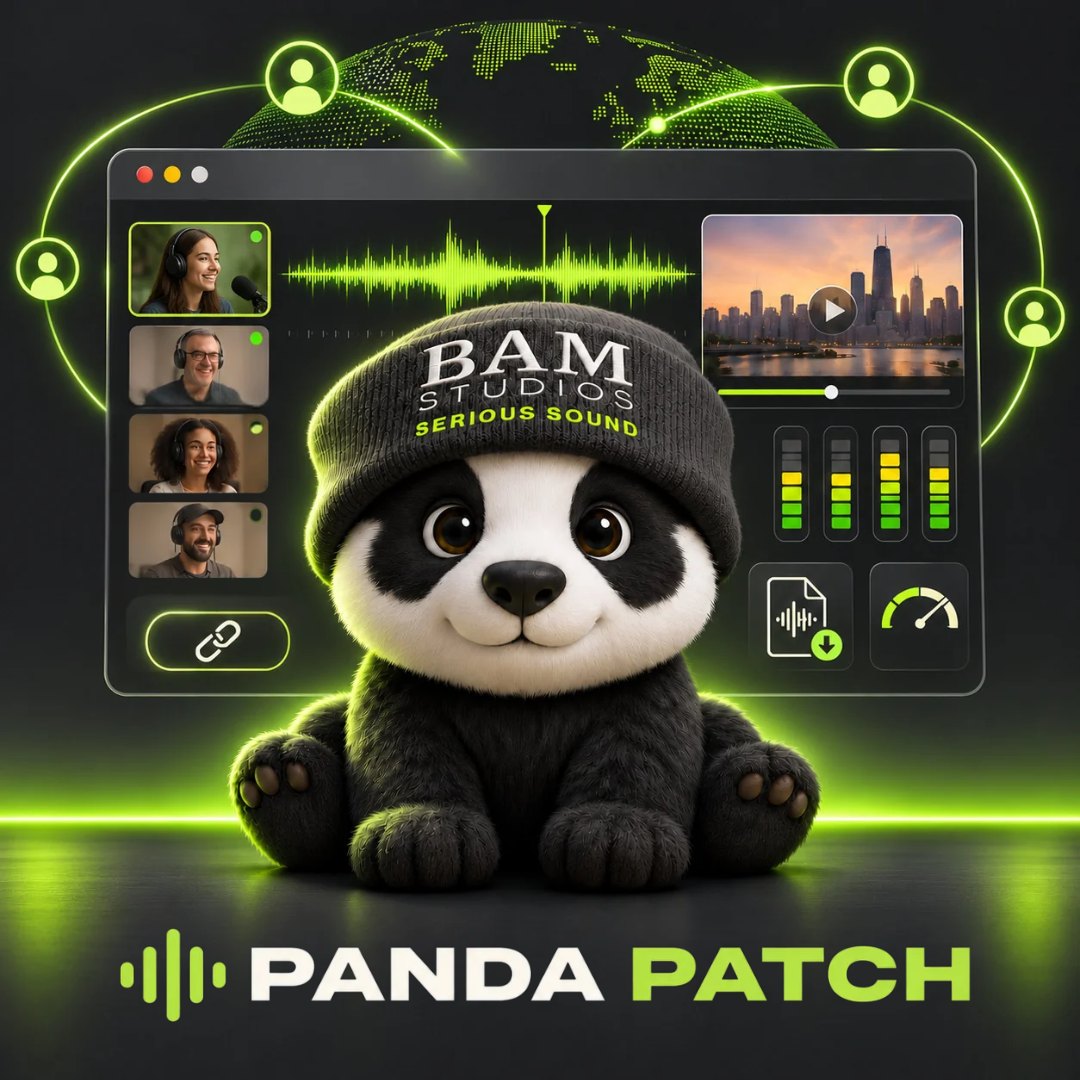
Panda Patch is BAM’s own software platform designed to simplify professional remote audio sessions.
The idea is straightforward: create an easier way to connect talent, engineers, directors, producers, creatives, and clients without requiring everyone to understand professional audio technology just to join a session.
For the engineer, the connection still needs to be high quality, dependable, and flexible. For everyone else, it should feel simple.
A director should be directing. An actor should be performing. A producer should be producing. They shouldn’t be spending the beginning of a session troubleshooting software.
Why We Built It
BAM has been recording remotely since long before remote recording became commonplace.
We’ve watched the technology evolve from dedicated ISDN lines and hardware codecs to today’s software- and browser-based audio and video platforms. Each generation has made things easier, but the overall workflow can still be fragmented.
One application may handle high-quality audio. Another handles video. Someone joins through Zoom. Talent may have an entirely different setup at their end.
It works. We do it all the time.
But we started asking whether all those pieces always needed to be separate. Instead of designing around how remote audio technology traditionally works, we started thinking about how we actually wanted a session to work.
Panda Patch grew out of that question.
Designed From the Engineer’s Chair
One advantage we had developing Panda Patch is that we weren’t guessing how professional recording sessions operate. We live in them.
BAM’s engineers spend their days working with actors, directors, agencies, producers, editors, production companies, and post teams. That experience shaped the application from the beginning.
How quickly can someone get connected? How much explanation does the talent need? What does the engineer need to see and control? How do we make something professional enough for everyday production but simple enough for someone who may use it only once?
The goal was never to create the application with the most buttons.
The goal was to create one that gets out of the way.
Built Around the Digital Patch
At BAM, we’ve long referred to this type of remote studio connection as a digital patch — electronically connecting the studio with talent, clients, directors, producers, or another studio somewhere else in the world.
Panda Patch takes that familiar audio-post concept and turns it into a modern software platform.
And because we’re developing it ourselves, we can continue shaping it around what our engineers and clients actually need instead of adapting our workflow around someone else’s software.
Tested in Real Sessions
Software can work beautifully in a controlled test. That doesn’t necessarily mean it will work when talent is sitting in a hotel room thousands of miles away.
One of our early real-world Panda Patch sessions gave us exactly that kind of test.
Talent connected to BAM from a hotel in Tuscany using a laptop and hotel Wi-Fi. Panda Patch carried the audio connection while Zoom handled video.
And it worked.
In another session, we recorded an actor doing ADR for a television episode that was scheduled to air just two days later. The actor joined Panda Patch on a cell phone, watched the episode directly in the app, and recorded using the phone’s built-in microphone — while standing in a forest.
Not exactly a traditional ADR stage.
But the session got done.
We’ve continued using and testing Panda Patch in real production environments because that’s where the most valuable development happens. You quickly discover what matters, what doesn’t, and what needs to be easier.
That’s how we want Panda Patch to evolve: inside actual sessions.
More Than Just Audio
Remote recording has also become increasingly visual.
ADR obviously requires picture, but advertising, animation, VO, podcasts, and other sessions increasingly involve video too. Clients may want to see talent. Directors want face-to-face communication. Producers may need to watch an edit. Everyone may need to see picture while listening to the session.
That’s why video and picture are part of the larger Panda Patch development path.
Our goal isn’t simply to transport audio from Point A to Point B. It’s to create a better remote session environment.
Simple Can Still Be Professional
There is sometimes an assumption that professional software needs to look complicated.
We disagree.
Great technology can hide enormous complexity behind a simple interface. That philosophy has influenced Panda Patch’s visual design as much as its technical development.
We want it to feel clean, modern, intuitive, and professional. More importantly, we want someone opening Panda Patch for the first time to understand what to do.
The engineering behind it may be complicated. The experience shouldn’t be.
Software Built by an Audio Post Studio
That’s probably the most unusual thing about Panda Patch.
We’re not a software company trying to figure out the audio business. We’re an audio post company that decided to build software.
There is an important difference.
Every feature ultimately comes back to one question:
Would this make an actual session better?
If the answer is yes, it’s worth exploring.
Panda Patch isn’t meant to replace every other remote-recording platform. Different productions require different workflows, and BAM continues to support the professional technologies our clients use.
It simply gives our engineers another option — one designed specifically around the way we work.
The Studio Beyond the Studio
We still believe deeply in physical studios. Great rooms matter. Acoustics matter. Monitoring matters. Microphones matter. Engineers matter.
But today’s audio post studio also has to extend beyond its walls.
BAM may be physically located in Chicago while a single session connects people across several cities, states, or countries. The studio becomes the hub.
Panda Patch is part of how we’re thinking about that hub — extending the BAM studio experience beyond the studio itself.
Panda Patch is still evolving. We use it. We test it. We improve it. Then we put it back into real sessions and learn some more.
Audio post has always been a combination of creativity and technology. The equipment has changed dramatically over the years, but the fundamental job hasn’t:
Connect talented people. Give them the right tools. Remove the obstacles. And let them do great work.
That’s why we built Panda Patch.
To learn more about Panda Patch and see what we’re building, visit PandaPatchApp.com.
If you have a remote recording session coming up and want to talk through the best way to connect talent, clients, directors, and your production team, we’d be happy to help.
By Brian Reed
President & CEO, BAM Studios
November 18th, 2026
BAM Studios is a Chicago-based audio post-production company specializing in sound mixing, ADR, voiceover recording, sound design, podcast production, and immersive audio for film, television, advertising, and digital media.